
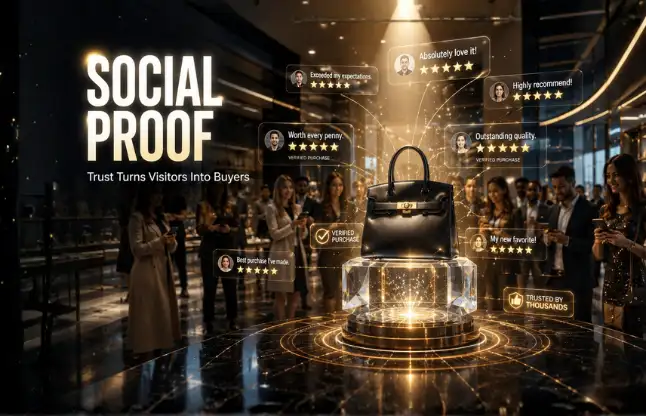
How Social Proof Influences Customer Buying Decisions in 2026
When I am about to buy something online, I rarely make the decision based only on the product description. I usually look for something else first. I check the reviews, see what other customers are saying, look at comments, and sometimes visit the brand’s social media pages to understand whether the business is actually trusted by real people.
That small habit says a lot about how online buying has changed.
In 2026, customers have more choices than ever. Almost every product or service has dozens of alternatives, and switching from one brand to another takes only a few clicks. Because of that, trust has become one of the most valuable things a business can build online. This is where social proof marketing becomes important.
Social proof is basically the idea that people feel more comfortable choosing something when they can see that other people have already chosen, used, recommended, or interacted with it. A positive review, an Instagram comment, a customer testimonial, a creator recommendation, or even strong social media engagement can influence how someone feels about a brand.
The interesting part is that social proof does not only work for huge companies. Small businesses, creators, online stores, agencies, freelancers, and startups can all use it to make their brands look more trustworthy.
What Is Social Proof Marketing?
Social proof marketing is the practice of using real customer experiences, opinions, interactions, recommendations, and community activity to build trust around a product, service, or brand.
Think about the last time you searched for a restaurant online. If one restaurant had two reviews and another had hundreds of reviews with detailed customer comments, you would probably feel more comfortable considering the second one.
The same principle applies to online businesses.
A customer may discover a brand through an advertisement, but social proof can help convince them that the brand is worth trying. It answers a question that most buyers have before spending money:
“Can I trust this business?”
This matters even more when the customer has never heard of the company before. A professional website can create a good first impression, but reviews, testimonials, social media activity, and customer-generated content can make the brand feel more established.
Why Social Proof Matters More in 2026
Online customers have become better at researching before buying. They can compare prices, read reviews, watch product demonstrations, check social profiles, and search for opinions within minutes.
At the same time, people have also become more cautious.
A polished advertisement is not always enough anymore. Customers want evidence. They want to know that someone else has had a good experience before they commit their own money.
This is one reason social proof has become such an important part of social media marketing.
A brand with an active community can feel more credible than an account that looks abandoned. A product with genuine customer reviews can feel safer than one with no feedback. A creator who openly demonstrates a product can make it easier for potential buyers to understand what they are actually getting.
Social proof does not replace product quality. It supports it.
If the product is poor, no amount of marketing can create long-term customer loyalty. But when a good product is combined with genuine social proof, the buying journey becomes much easier.
1. Customer Reviews Are Still One of the Strongest Forms of Social Proof
Customer reviews are probably one of the first things people check before purchasing online.
A potential customer wants to know whether the product works, whether delivery was reliable, whether customer service was helpful, and whether the experience matched the company’s promises.
That is why businesses should make it easy for satisfied customers to leave honest feedback.
The key word here is honest.
Businesses should not create fake reviews simply to make their rating look better. Fake feedback can damage trust if customers discover it, and modern buyers are often good at spotting reviews that sound unnatural.
A useful review usually contains specific details. Instead of simply saying “Great service,” a customer might explain what they purchased, how quickly they received it, and what they liked about the experience.
Those details make the review more believable.
2. Testimonials Turn Customer Experiences Into Stories
Testimonials work slightly differently from ordinary reviews.
A review might be a short comment on a product page, while a testimonial can explain the customer’s journey in greater detail.
For example, a small business owner might explain how a particular marketing service helped them improve their social media presence. A creator might describe how they became more consistent with content after finding the right tools. An online store owner could explain how better social engagement helped attract more attention to new products.
These stories are powerful because potential customers can see themselves in them.
Instead of simply hearing a company say, “Our service works,” they see another person explaining what happened after using it.
That difference can have a strong influence on buying decisions.
3. User-Generated Content Makes Brands Feel More Real
User-generated content, often called UGC, is another major form of social proof.
This includes photos, videos, Instagram posts, unboxing videos, product demonstrations, comments, reviews, and other content created by customers or members of a community.
UGC works because it does not always feel like traditional advertising.
Imagine two product pages. One has professionally produced promotional images created entirely by the company. The other also includes videos from customers showing how they actually use the product.
The second page may feel more relatable.
That does not mean professional content is unnecessary. Instead, the best strategy is often to combine polished brand content with genuine customer experiences.
When people can see how others use a product in everyday situations, it becomes easier to imagine using it themselves.
4. Influencer Recommendations Can Reduce Buying Hesitation
Influencer marketing has changed significantly over the years.
Today, brands do not necessarily need a celebrity with millions of followers. In many cases, smaller creators with focused communities can provide valuable recommendations because their audiences may trust them more.
For example, someone who regularly creates content about fitness may have more influence over a fitness-focused audience than a general celebrity.
The important factor is relevance.
If an influencer recommends a product that clearly fits their content and audience, the recommendation can feel natural. If they promote completely unrelated products every day, followers may become less responsive.
For brands, the lesson is simple: choose relevance over follower count alone.
The right creator should have an audience that actually cares about the product.
5. Social Media Engagement Is Its Own Form of Social Proof
Likes, comments, shares, views, saves, and followers can also influence how people perceive a brand.
Imagine discovering two similar Instagram accounts. One has consistent content, active comments, regular views, and an audience that appears to interact with its posts. The other has very little activity.
Even before reading the company’s description, you may naturally feel more confident about the first account.
This is one reason social media engagement can affect purchasing decisions indirectly.
For example, Free Instagram Likes, Free Instagram Views, and Free Instagram Followers may be searched by people who are looking for ways to increase their social presence without immediately spending money. These approaches can be useful as part of an overall growth strategy, but businesses should remember that numbers alone do not create genuine trust.
Engagement becomes much more meaningful when it is supported by useful content, real conversations, customer feedback, and an active community.
Social Proof Should Support Real Marketing, Not Replace It
This is an important distinction.
A business should never think of social proof as a shortcut that replaces quality products or customer service.
If someone sees an Instagram account with thousands of followers but notices that nobody comments, the numbers may not help much. Likewise, a website can have hundreds of reviews, but if every review sounds identical, customers may become suspicious.
The strongest social proof comes from a combination of signals.
A healthy online presence might include:
- Genuine customer reviews
- Helpful testimonials
- Real user-generated content
- Active social media conversations
- Relevant creator recommendations
- Consistent content
- Helpful replies to customer questions
- Visible proof of customer satisfaction
When these elements work together, customers have more reasons to trust the brand.
Can SMM Panel Services Help Build Social Proof?
For businesses that are trying to grow their social presence, SMM Panel Services can be one part of the broader strategy.
An SMM panel can provide access to different social media growth services, allowing businesses or marketers to manage campaigns and improve the visibility of social profiles.
However, there is an important difference between building visibility and building trust.
Services can help a profile gain more exposure or improve its social presence, but genuine trust still comes from content quality, customer experiences, communication, and authentic engagement.
This is why businesses should think of SMM services as a supporting tool rather than the entire marketing strategy.
For example, a brand could use an SMM service to strengthen the initial visibility of a new social profile while simultaneously publishing useful content, encouraging real customer feedback, responding to comments, and building relationships with its audience.
That combination is much more sustainable.
What About SMM Panel India?
The demand for social media growth services is not limited to one country.
Businesses around the world are looking for practical ways to improve their online presence, and SMM Panel India is one search category that reflects the growing interest in social media marketing services from Indian providers and users.
India has a large and highly active digital audience, which creates opportunities for creators, businesses, agencies, and online sellers.
At the same time, global customers have similar concerns regardless of where they live. They want reliable services, transparent pricing, quality support, and results that make sense for their goals.
That means businesses should evaluate an SMM provider based on service quality and reliability rather than choosing one simply because it is located in a particular country.
How I Would Build Social Proof for a New Brand
If I were starting a new online business today, I would not try to make the brand look famous overnight.
I would focus on making it look active, useful, and trustworthy.
First, I would create a complete social media profile with clear branding and an understandable description of what the business offers. There is no point attracting visitors if they cannot figure out what the company actually does.
Next, I would publish useful content consistently.
The content would answer questions, demonstrate products, share customer experiences, and explain things in a way that helps potential buyers.
After that, I would actively collect feedback from real customers. Even a small number of detailed reviews can be more useful than a large collection of vague comments.
I would also encourage customers to share their experiences through photos, videos, stories, or posts where appropriate.
Finally, I would use social media growth services carefully when they make sense for the campaign. The goal would not be to create fake popularity. The goal would be to improve visibility while the business continues building genuine engagement.
A Practical Social Proof Strategy for Small Businesses
You do not need a huge marketing budget to start.
Here is a simple approach.
Step 1: Make your profile trustworthy.
Use a recognizable profile picture, clear description, website link, contact information, and consistent branding across platforms.
Step 2: Publish useful content.
Do not make every post a sales pitch. Answer questions, share tips, show behind-the-scenes content, and explain how your product or service solves a problem.
Step 3: Ask happy customers for feedback.
Make the process simple. A short review request after a successful purchase can generate valuable feedback.
Step 4: Turn good experiences into content.
With customer permission, testimonials and UGC can become social media posts, website content, or case studies.
Step 5: Encourage conversations.
Reply to comments and questions. A quiet account can make a business look inactive, while thoughtful conversations show that there are real people behind the brand.
Step 6: Use growth services responsibly.
If you use SMM Panel Services, choose services that support your broader marketing plan rather than relying entirely on follower or engagement numbers.
Step 7: Keep improving.
Social proof is not something you build once. It grows as more customers interact with your business.
Why Authenticity Still Wins
There is a temptation in social media marketing to chase numbers.
More followers. More views. More likes. More comments.
Numbers can certainly help with visibility, but they should not become the only goal.
A customer who discovers your brand may look beyond the follower count. They might read your captions, inspect your comments, search your brand name, check reviews, and look at how you respond to customers.
That is why authenticity matters.
If you are using tools or services to improve your social presence, make sure the rest of your marketing supports the image you are creating.
For example, if you gain more visibility but your website is confusing, customers may still leave. If your posts receive attention but nobody receives a response to a product question, trust can disappear quickly.
The best social proof strategy connects everything together.
Where SMM Services Fit Into a Modern Growth Strategy
SMM services can be useful for brands that understand what they want to achieve.
A creator launching a new Instagram page may want more initial visibility. A small business may want to improve its social presence before running paid campaigns. An agency may need a scalable way to manage social media growth for several clients.
Platforms such as TopsmmAgency can be considered as part of this broader approach, especially when businesses are looking for structured social media marketing services.
But the strategy should always start with the audience.
Ask yourself:
Who am I trying to reach?
What problem am I solving?
Why should someone trust me?
What evidence can I show them?
Once those questions are answered, social proof becomes much easier to build.
Social Proof and the Customer Buying Journey
Social proof can influence customers at different stages.
At the discovery stage, strong social engagement can make a brand look active enough to explore.
During the research stage, reviews, testimonials, and UGC can answer questions and reduce uncertainty.
At the decision stage, recommendations and positive customer experiences can give buyers the final confidence they need.
After the purchase, the customer can become part of the next layer of social proof by leaving a review, sharing a photo, or recommending the product to someone else.
This creates a cycle:
Customer experience → feedback → social proof → new customer → new experience.
That cycle is one of the most valuable things a growing business can build.
Final Thoughts
Social proof has become much more than a collection of likes and follower numbers.
In 2026, customers are surrounded by choices. They want reasons to believe that a brand is reliable before they spend their money. Reviews, testimonials, user-generated content, influencer recommendations, and social media engagement all help answer that need.
For me, the biggest lesson is that social proof works best when it feels natural.
Do not try to make a business look bigger than it really is. Instead, give customers enough genuine evidence to understand why other people trust the brand.
Use social media marketing to create useful conversations. Use customer feedback to strengthen credibility. Use SMM services where they genuinely support your growth plan. And if you use growth tools, make sure they are working alongside authentic content and real customer relationships.
That is where services such as TopsmmAgency can fit into the picture: helping businesses work on their social presence while they continue building the deeper trust that turns visitors into customers.
The strongest online brands are not simply the ones with the biggest numbers. They are the ones where those numbers are supported by something real — useful content, satisfied customers, active communities, and a brand people feel comfortable buying from.
And in 2026, that kind of trust can be one of your biggest competitive advantages.
Frequently Asked Questions (FAQs)
1. What is social proof marketing?
Social proof marketing uses reviews, testimonials, UGC, influencer recommendations, and social engagement to build customer trust.
2. Why does social proof influence buying decisions?
It reduces customer doubts by showing that other people already trust, use, or recommend a product or service.
3. What are the main types of social proof?
The main types include customer reviews, testimonials, UGC, influencer recommendations, ratings, and social media engagement.
4. Can SMM Panel Services help with social proof?
Yes. SMM Panel Services can improve social visibility, but they work best alongside authentic content and genuine customer engagement.
5. How can businesses build social proof naturally?
Businesses can collect honest reviews, share UGC, encourage customer feedback, work with relevant creators, and stay active on social media.
- No Comments
- August 21, 2026