
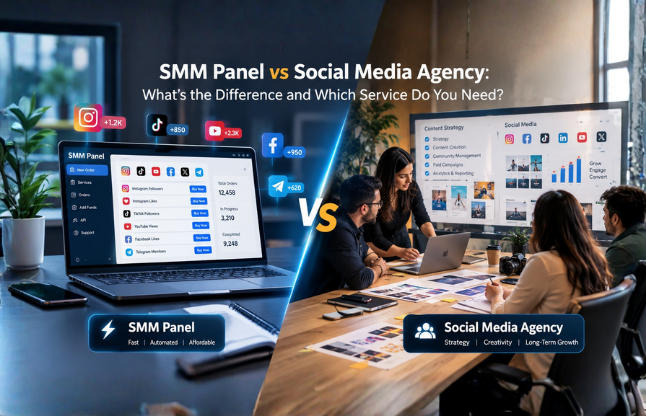
SMM Panel vs Social Media Agency: What’s the Difference and Which Service Do You Need?
Social media has become one of the easiest ways for businesses to connect with customers, build brand awareness, and bring more attention to their products or services. But when you start looking for help with social media growth, you will quickly come across two common options: an SMM Panel and a social media agency.
At first, both options may appear to do the same thing. However, they work in very different ways. An SMM Panel usually allows you to select and order individual social media services yourself, while a social media agency normally provides a broader strategy and manages different parts of your social media marketing.
The right choice depends on your goals, budget, experience, and how much control you want over your campaigns. A small business looking for a specific service may not need a full agency, while a growing brand that needs content, strategy, advertising, and reporting may benefit from professional management.
In this guide, we will break down the difference between an SMM Panel vs Social Media Agency, explain when each option makes sense, and look at how you can measure whether your social media efforts are actually producing useful results.
What Is an SMM Panel?
An SMM Panel is an online platform where users can purchase different social media marketing services from one place. Depending on the provider, you may find services related to Instagram, YouTube, Facebook, TikTok, and other popular social platforms.
Instead of hiring someone to manage your entire social media account, you can usually choose a specific service based on what you need. You select the service, provide the required details, choose the quantity or package, and place your order through the platform.
This makes SMM panels attractive to creators, freelancers, marketers, small businesses, and agencies that want a simple way to access social media services. They can also be useful for people who want more control over when and how they use their marketing budget.
However, an SMM panel is not the same thing as a complete social media strategy. It can provide specific services, but you still need to think about your content, audience, branding, website, customer journey, and overall marketing goals.
What Are SMM Panel Services?
SMM Panel Services are individual social media services that can be ordered through an SMM platform. The exact services available depend on the provider, but they may include Instagram likes, followers, views, story views, YouTube services, TikTok engagement, Facebook services, and other social media solutions.
For example, a business launching a new Instagram campaign may want additional visibility around specific content. Instead of signing a long-term contract with an agency, the business may choose individual services that fit its current campaign and budget.
This flexibility is one of the main reasons people use SMM panels. You are not necessarily paying for services that you do not need. You can choose what you want and decide when you want to use it.
Still, it is important to understand that social media numbers are only one part of marketing. More followers or views do not automatically mean more customers. The real value comes from combining visibility with quality content, relevant audiences, website traffic, leads, and conversions.
What Is a Social Media Agency?
A social media agency usually works on a much wider range of activities than an SMM panel. Instead of simply providing individual services, an agency may help create and manage a complete social media marketing strategy for your business.
Depending on the agency and package, this can include content planning, social media posts, graphic design, copywriting, scheduling, community management, paid advertising, competitor research, analytics, and monthly reporting.
This can be helpful for business owners who do not have enough time or experience to manage social media themselves. Rather than logging into different platforms every day and planning everything from scratch, you can work with a team that handles much of the process.
The main trade-off is cost. Professional agency services normally cost more because you are paying for strategy, creative work, management, communication, research, and ongoing optimization rather than simply purchasing one social media service.
SMM Panel vs Social Media Agency: What Is the Difference?
The simplest way to understand the difference is to look at how the service is delivered.
An SMM Panel gives you direct access to individual services, allowing you to decide what you need and when you need it. A social media agency usually takes a more involved role by planning campaigns, creating content, managing accounts, and analysing performance.
With an SMM Panel, you generally have more direct control over your orders and spending. With an agency, you hand over more responsibility to professionals who work according to an agreed strategy.
Here is a simple comparison:
Feature | SMM Panel | Social Media Agency |
Main purpose | Individual social media services | Complete social media management |
Control | More direct control | Shared with agency |
Strategy | Usually limited | Usually included |
Content creation | Depends on provider | Commonly included |
Account management | Usually self-managed | Often handled by agency |
Cost | Usually more affordable | Generally more expensive |
Flexibility | High | Depends on package |
Best for | Specific service requirements | Long-term marketing management |
Reselling | Often available | Not usually the main purpose |
Reporting | Order/service focused | Campaign and business focused |
Neither option automatically works for every business. The better choice depends on what you actually need from your social media marketing.
When Should You Choose an SMM Panel?
An SMM Panel can be useful if you already understand your social media strategy but need specific services to support it. You may already have someone creating content and managing your accounts, but occasionally need additional services for particular campaigns.
It can also be useful if you are working with a smaller budget and do not want to commit to a monthly agency package. Instead of paying for a complete service, you can select individual services according to your current requirements.
Freelancers and marketers may also use panels because of their flexibility. Some providers offer SMM reseller services, allowing marketers to purchase social media services and include them within their own client packages.
If you choose this route, do not look at price alone. Check the provider’s service information, support, delivery details, policies, and reputation before placing an order. A low price is not useful if the service does not fit your actual marketing goals.
When Should You Choose a Social Media Agency?
A social media agency can be a better fit when you need someone to manage several parts of your social media marketing at the same time.
For example, imagine you own an online store. You may need a monthly content calendar, Instagram posts, videos, captions, paid advertising, audience research, community management, and performance reports. Managing all of these activities internally can take a considerable amount of time.
An agency can take responsibility for planning and executing those activities based on your business goals. This can be especially useful when social media is an important part of your customer acquisition strategy.
The downside is that agencies generally require a larger budget. You may also have meetings, approval processes, monthly retainers, and longer commitments depending on the agency you choose.
What About Affordable SMM Services?
Budget is one of the biggest reasons businesses compare an SMM Panel with a social media agency.
Affordable SMM services can be useful for startups, small businesses, creators, freelancers, and marketers who want to manage their spending carefully. Instead of paying for a complete social media management package, you can select specific services that fit your needs.
However, affordability should never be the only factor you consider. Before spending money, ask what you actually want the campaign to achieve and how you will measure the result.
If you want awareness, look at reach and impressions. If engagement is your goal, monitor interactions and engagement rates. If you want sales, track website visits, leads, conversions, and revenue.
A cheaper service is not automatically more valuable. The real question is whether the service contributes to the result your business needs.
Don’t Judge Social Media Success Only by Followers
It is easy to become obsessed with follower numbers because they are visible and simple to understand. However, followers alone do not tell you whether your social media marketing is working.
A business can gain thousands of followers and still receive very few enquiries or sales. At the same time, a smaller account can generate strong results if its audience is relevant and engaged.
This is why you should look at the entire customer journey. Start with reach, then examine engagement, website traffic, leads, conversions, customer acquisition, and finally the return you receive from your investment.
When you look at these numbers together, you get a much clearer picture of what your social media activity is actually doing for your business.
Measure Your Social Media Reach
Reach tells you how many unique people have seen your content. It is useful for understanding whether your content is getting in front of a larger audience.
If your reach increases consistently, it can indicate that your content is being discovered by more people. But high reach does not automatically mean that those people are interested in your products or services.
Always consider the quality of the audience you are reaching. A smaller audience that matches your target customers can be more useful than a large audience with little connection to your business.
Track Engagement
Engagement includes likes, comments, shares, saves, replies, and other interactions with your content. It helps you understand whether people are doing more than simply scrolling past your posts.
For example, if a post receives many saves and shares, that may tell you the content is useful enough for people to keep or recommend to others. Comments and direct messages can also give you insight into what your audience actually wants.
Do not simply chase the largest possible engagement number. Look at the type of engagement you are receiving and whether it is coming from people who could realistically become customers.
Watch Your Website Traffic
If your social media strategy is designed to bring people to your website, website traffic should be one of your key measurements.
Analytics tools can show how many visitors are coming from different social media platforms. You can then compare traffic from Instagram, Facebook, YouTube, TikTok, LinkedIn, or other channels.
This helps you understand which platforms are actually sending people to your website rather than simply generating social media activity.
You can take this a step further by tracking specific campaigns and links. That makes it easier to identify which posts and promotions are generating useful traffic.
Measure Leads
For many businesses, leads are more important than likes.
A lead could be someone who fills out a contact form, requests a quotation, sends an enquiry, books a consultation, signs up for an email list, or contacts your sales team through social media.
If your social media activity is producing relevant leads, you are beginning to connect social media marketing with real business opportunities.
This is particularly important for service-based businesses where a single customer can be worth significantly more than the cost of the original social media campaign.
Track Conversions
Conversions tell you whether people are completing the action you actually want them to take.
For an ecommerce business, a conversion might be a purchase. For a marketing agency, it could be a consultation booking. For a SaaS company, it could be a free trial registration.
The definition of a conversion depends on your business model. That is why you should decide what your main conversion action is before launching a campaign.
Once you know what counts as a conversion, you can compare different campaigns and determine which ones are producing meaningful results.
Calculate Customer Acquisition Cost
Customer acquisition cost, often called CAC, tells you how much it costs to acquire a new customer.
For example, imagine you spend $1,000 on social media marketing and gain 20 new customers. Your simple acquisition cost would be $50 per customer.
This number becomes much more useful when compared with how much revenue or profit those customers generate over time.
If your average customer is worth significantly more than your acquisition cost, your marketing may have room to scale. If acquisition costs continue increasing without a corresponding increase in customer value, you may need to review your strategy.
Measure Social Media ROI
One of the most important measurements is social media ROI.
A basic formula is:
Social Media ROI = (Revenue Generated − Marketing Cost) ÷ Marketing Cost × 100
For example, if you spend $2,000 on social media marketing and generate $6,000 in directly attributed revenue, the calculation would be:
($6,000 − $2,000) ÷ $2,000 × 100 = 200% ROI
This is a simplified example because real marketing attribution can be complicated. Someone may see your Instagram content today, visit your website a week later, and finally purchase after receiving an email.
That is why businesses should look at multiple measurements rather than relying on one number. ROI is important, but reach, engagement, traffic, leads, conversions, and customer value can all help explain why your results look the way they do.
What Is an SMM Panel India?
You may also see the term SMM Panel India when searching for social media marketing services online.
Indian SMM panels can be useful for businesses, marketers, and resellers who are specifically looking for services from providers operating in or serving the Indian market. Pricing, payment methods, support, and service availability can vary from provider to provider.
However, businesses targeting international customers should not choose a service simply because it is labelled as an Indian SMM Panel.
If your target audience is global, consider whether the service fits your audience, campaign, platform, and marketing objectives. The provider’s location is only one factor among many.
Can You Use an SMM Panel and Agency Together?
You do not necessarily have to choose one option.
Some businesses can use an agency for strategy, content, advertising, and account management while using selected SMM services for specific campaigns.
For example, your internal marketing team may create the content and manage your brand strategy, while an SMM Panel provides particular services when needed.
This approach can give you more flexibility, but it needs proper planning. Everyone involved should understand what services are being used, what they are intended to accomplish, and how the results will be measured.
Without clear tracking, it becomes difficult to know whether a particular service is actually helping your business.
What Should You Check Before Choosing an SMM Provider?
Before using an SMM provider, take some time to understand exactly what you are purchasing.
Look for clear service descriptions, transparent pricing, realistic delivery information, customer support, and understandable policies. A professional-looking website alone is not enough to judge service quality.
Be cautious of providers making unrealistic promises. No genuine service can guarantee that every post will go viral or that a particular campaign will automatically generate customers.
You should also consider the platform’s rules and your own marketing objectives. Social media growth should support your wider strategy rather than become a replacement for good content and genuine customer relationships.
How TopsmmAgency Can Help You Explore SMM Options
At TopsmmAgency, the goal is to make social media marketing easier to understand for businesses, creators, marketers, and people who are exploring different growth options.
Whether you are researching an SMM Panel, comparing SMM Panel Services, or considering professional social media marketing services, the first step should always be understanding what you want to achieve.
Once your goal is clear, you can decide whether you need individual services, ongoing management, or a combination of both.
For readers who are specifically looking for social media growth services, you can also explore InstantLikes through InstantLikes.co. It can be a useful next step if you want to look at available social media services after learning about the differences between panels and agencies.
The important thing is not to purchase a service simply because it promises a bigger number. Think about how that service fits into your content strategy, audience, website traffic, lead generation, and overall customer journey.
Final Thoughts
The difference between an SMM Panel vs Social Media Agency mainly comes down to the level of service and control you need.
An SMM Panel can give you direct access to individual services and allow you to control your spending and campaigns. It can be useful for businesses, creators, freelancers, marketers, and people who need specific services without hiring an agency for complete management.
A social media agency usually takes a broader approach. It can handle strategy, content, campaigns, community management, advertising, analytics, and reporting, making it more suitable for businesses that want ongoing professional support.
There is also no need to treat the two options as completely separate. Depending on your resources and goals, you may use an agency for strategic work while using selected SMM services for specific requirements.
Most importantly, do not measure your social media efforts only by followers, likes, or views. Look at the full picture: reach, engagement, website traffic, leads, conversions, customer acquisition, and ROI.
When you connect social media activity with actual business outcomes, it becomes much easier to understand what is working, what needs improvement, and where your marketing budget should go next.
Frequently Asked Questions (FAQs)
1. What is the difference between an SMM Panel and a social media agency?
An SMM Panel provides individual social media services, while a social media agency usually handles strategy, content, campaigns, and account management.
2. Is an SMM Panel cheaper than a social media agency?
Generally, yes. SMM Panels allow you to purchase specific services, while agencies charge for broader marketing support and ongoing management.
3. Who should use SMM Panel Services?
SMM Panel Services can be useful for businesses, creators, freelancers, marketers, and resellers who need specific social media services with flexible spending.
4. How can I measure social media marketing results?
Track reach, engagement, website traffic, leads, conversions, customer acquisition costs, and ROI to understand whether your social media efforts are producing results.
5. Can I use an SMM Panel and social media agency together?
Yes. You can use an agency for strategy and management while using selected SMM services for specific campaigns or social media growth requirements.
- No Comments
- September 28, 2026