
How to Create a Social Media Growth Funnel From Followers to Customers
Getting followers on social media feels great, but followers alone do not always bring sales. A business can have thousands of followers and still struggle to generate website visits, enquiries, or actual customers. The real value of social media comes from what happens after someone discovers your brand and decides to take the next step.
This is where a Social Media Growth Funnel becomes useful. Instead of looking at followers, likes, and views as the final goal, a funnel helps you understand the complete journey from discovering your business to becoming a customer. It gives you a simple way to connect social media activity with leads, conversions, customer acquisition, and revenue.
Whether you are running an online store, personal brand, service business, startup, or established company, the basic process is similar. You need to attract the right audience, give them a reason to engage, build trust, guide them toward your website, and make the buying process as simple as possible.
What Is a Social Media Growth Funnel?
A Social Media Growth Funnel is the journey a person takes from discovering your social media account to eventually becoming a customer. Someone may first see one of your posts, then visit your profile, follow your account, check your website, ask a question, compare your offer with competitors, and finally make a purchase.
The important thing to understand is that people do not always move through this journey in a straight line. Someone might discover your brand today and buy next week, while another person may follow you for several months before becoming a customer. Your job is to create useful content and clear opportunities that keep interested people moving forward.
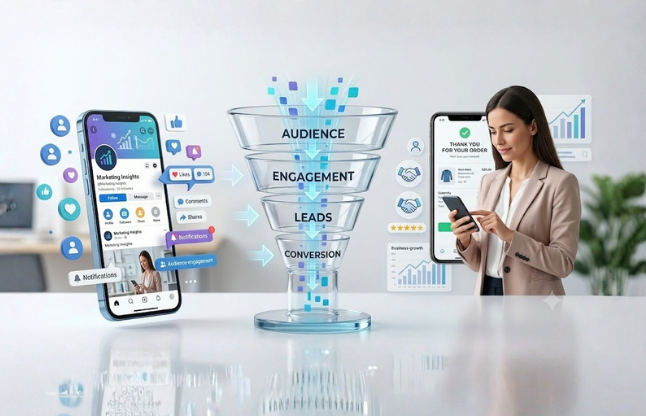
A simple social media funnel can look like this: Awareness → Engagement → Consideration → Lead → Conversion → Customer → Repeat Customer. Each stage has a different purpose, and each stage should be measured differently.
Why Followers Are Not the Final Goal
Follower count is one of the easiest social media numbers to notice, so it is understandable that businesses pay attention to it. Watching an account grow from 1,000 followers to 10,000 followers can certainly indicate that your content is reaching more people. However, a larger audience does not automatically mean more revenue.
Imagine a business with 50,000 followers that receives only a few customer enquiries every month. Another business might have 7,000 followers but generate regular leads and sales from its content. If you only compare follower numbers, you would miss the more important part of the story.
That is why businesses should measure the complete customer journey. Reach, engagement, profile visits, website traffic, leads, conversions, customer acquisition cost, and revenue can tell you much more about whether your social media efforts are actually working.
Stage 1: Attract the Right Audience
The first stage of a Social Media Sales Funnel is awareness. At this point, most people who see your content may know very little about your business. Some may not even be actively looking for your product or service yet, so your first job is to get their attention and give them a reason to remember you.
Educational posts, short videos, tutorials, industry tips, entertaining content, carousels, and problem-solving posts can all help with discovery. For example, a digital marketing business might publish tips about improving Instagram engagement, creating better content, or understanding social media analytics. People looking for that information may discover the business naturally through search or recommendations.
The goal at this stage is not to force everyone to buy something immediately. You are introducing your brand to potential customers and showing them that your account can provide something useful. Good awareness content creates curiosity and gives people a reason to visit your profile.
What Should You Measure at This Stage?
Start with basic awareness metrics such as reach, impressions, video views, non-follower reach, profile visits, and follower growth. These numbers help you understand whether your content is reaching new people and whether those people are interested enough to investigate your account further.
For example, if your reach increases significantly but profile visits remain almost unchanged, your content may be getting attention without creating enough curiosity. That does not necessarily mean the content is bad, but it tells you that there is an opportunity to improve your hooks, captions, branding, or calls to action.
Stage 2: Turn Attention Into Engagement
Once someone discovers your content, the next step is to create interaction. Likes, comments, shares, saves, replies, and direct messages can all show that people are doing more than simply scrolling past your post.
However, not every interaction has the same value. A person who saves a detailed tutorial may have stronger interest than someone who casually likes a post. Someone who sends a direct message asking about your service may be much closer to becoming a customer than someone who watches a five-second video.
This is why businesses should look beyond total likes. Study which types of content generate comments, shares, saves, profile visits, and conversations. Over time, these patterns can show you what your audience actually finds useful.
Stage 3: Build Trust Before Asking for a Sale
One of the biggest mistakes businesses make on social media is trying to sell too quickly. Someone who has just discovered your brand may not be ready to spend money. They may want to know who you are, whether your service is reliable, what other customers think, and whether your offer is suitable for their needs.
Trust-building content can include customer experiences, testimonials, case studies, product demonstrations, FAQs, educational posts, behind-the-scenes content, and useful explanations. You can also answer common questions openly instead of making every post promotional.
Your profile should make the business easy to understand. A new visitor should be able to see what you offer, who you help, and where they can learn more. When your content consistently answers questions and provides useful information, people have more reasons to trust the brand before making a purchase.
Stage 4: Move Interested Followers to Your Website
Social media is excellent for discovery and engagement, but your website can give potential customers a more complete place to learn about your products or services. This makes website traffic an important part of your social media marketing funnel.
Use relevant calls to action to guide people from social media to your website. Depending on your business, this could mean asking people to read an article, explore a service, view a product, request information, or check available options.
This is also where your TopsmmAgency blog can support your wider website strategy. Someone who discovers an educational article about social media growth may already have an interest in improving their online presence. If the article naturally introduces a relevant next step, that visitor can continue exploring instead of leaving after reading one page.
For readers who are specifically interested in social media growth services, you can naturally introduce InstantLikes as another destination to explore. The important thing is to make the recommendation relevant to the topic rather than inserting a promotional message that feels unrelated to the article.
Stage 5: Turn Social Traffic Into Leads
Not everyone who visits your website will be ready to purchase immediately. Some visitors are still comparing options, researching prices, or trying to understand which service is right for them. This is where lead generation becomes important.
A lead could be someone who fills out a contact form, sends a message, requests a quote, signs up for an email list, books a consultation, or takes another meaningful business action. Your social content should give interested visitors a clear and simple reason to take that next step.
Your call to action does not always need to say “Buy Now.” Depending on where someone is in the funnel, a softer action such as “Learn More,” “Explore the Services,” “Read the Full Guide,” or “Contact Us” may be more appropriate. Matching the CTA to the customer’s level of interest can make the journey feel much more natural.
Stage 6: Convert Leads Into Customers
Once someone becomes a lead, your focus shifts toward conversion. At this stage, the person already has some level of interest, so your website, product information, pricing, reviews, support, and buying process become especially important.
For example, imagine that 20,000 people see your social media content. Around 1,000 visit your profile, 300 visit your website, 40 become leads, and 10 eventually purchase. Those numbers tell you much more than the original 20,000 reach.
You can now identify where people are dropping out of the funnel. If many people visit your website but very few become leads, your landing page or offer may need attention. If you receive many leads but very few sales, you may need to examine your pricing, follow-up process, customer support, or product positioning.
How to Measure Your Social Media Growth Funnel
A funnel only becomes useful when you measure it. You do not need dozens of complicated metrics, but you should have a few numbers that help you understand what is happening at each stage.
At the awareness stage, focus on reach and impressions. At the engagement stage, examine interactions and engagement rate. Once people start visiting your website, track clicks and sessions. After that, measure leads, conversions, customer acquisition cost, and revenue.
This gives you a much clearer picture of your social media performance. Instead of saying, “Our Instagram post performed well,” you can say, “This campaign reached 30,000 people, generated 900 website visits, produced 70 leads, and resulted in 15 customers.”
That is the kind of information that can actually help you make better marketing decisions.
Measure Reach and Engagement
Reach tells you how many unique people were exposed to your content, while impressions tell you how many times content was displayed. Both are useful for understanding awareness, especially when you are trying to expand beyond your existing followers.
Engagement helps you understand what happens after people see your content. Look at likes, comments, shares, saves, replies, and other meaningful interactions. Compare engagement with reach instead of looking only at raw numbers.
For example, a post that reaches 100,000 people and receives almost no interaction may not be as valuable as a smaller post that reaches 10,000 highly interested people and generates dozens of conversations. The context behind the numbers matters.
Measure Website Traffic and Leads
Once people start clicking through to your website, you can begin measuring the quality of your social traffic. Track which platforms, campaigns, posts, and links are sending visitors to your site.
You should also measure how many visitors become leads. If 1,000 people visit your website and 50 submit an enquiry, your lead conversion rate is 5%. Comparing this number across different campaigns can help you understand which traffic sources are producing stronger results.
This is especially useful when you are testing different content styles. One campaign might generate lots of traffic but few leads, while another may produce less traffic but a much higher percentage of enquiries.
Measure Conversions and Customer Acquisition
Leads are useful, but businesses ultimately need customers. That means you should track how many social-generated leads eventually become paying customers.
You can also calculate your Customer Acquisition Cost, commonly called CAC. The basic calculation is:
Customer Acquisition Cost = Total Marketing Cost ÷ Number of New Customers
For example, if you spend $1,000 on social media campaigns and generate 20 new customers, your average acquisition cost is $50 per customer.
Once you know this number, you can compare it with the average value of your customers. This helps you understand whether your social media strategy is creating sustainable business results rather than simply generating attention.
Measure Social Media ROI
Return on investment is one of the most important numbers for any business. Social media can produce valuable results, but you need to understand whether the money and resources being invested are producing enough return.
A simple ROI calculation compares the profit generated by your marketing activity with the cost of that activity. Depending on your business model, you may also want to consider customer lifetime value rather than only the value of the first purchase.
For example, a customer who buys once for $30 but later spends $300 with your business has a very different value from a customer who makes only one small purchase. Looking at the complete customer relationship can give you a more realistic picture of social media performance.
Where SMM Panel Services Fit Into the Funnel
Some businesses include an SMM Panel as one part of their broader social media growth strategy. SMM services can be useful for businesses looking for specific social media support, but they should not be treated as a replacement for quality content, genuine audience relationships, strong branding, and conversion-focused marketing.
If you are researching an SMM Panel India or comparing providers that serve customers globally, look beyond the cheapest option. Consider factors such as service consistency, support, delivery quality, platform compatibility, transparency, and how the service fits into your overall marketing plan.
SMM Panel Services can support certain growth activities, but the bigger objective should remain the same: creating a social media presence that helps your business attract attention, build trust, generate interest, and ultimately create customers.
Instead of asking only how many followers or interactions a service can provide, ask how that activity fits into your complete funnel. This approach helps you avoid focusing on numbers that look impressive but do not contribute to your actual business goals.
Create Content for Every Funnel Stage
One of the easiest ways to improve a social media funnel is to stop creating the same type of content for everyone. A person who has never heard of your business needs different information from someone who has already visited your website several times.
At the top of the funnel, focus on discovery. Educational videos, quick tips, industry information, beginner guides, and problem-focused content can help introduce your brand to new people.
In the middle of the funnel, focus on trust and consideration. Case studies, demonstrations, comparisons, customer experiences, FAQs, and detailed educational content can help people understand why your product or service may be suitable for them.
At the bottom of the funnel, focus on action. Product benefits, testimonials, pricing information, service details, offers, and clear calls to action can help people make a decision when they are already interested.
When these three types of content work together, your social media account becomes more than a collection of random posts. It becomes part of a complete customer journey.
Do Not Forget Existing Customers
The funnel should not stop after someone makes a purchase. Existing customers can become repeat buyers, reviewers, referrers, and some of your most valuable sources of new business.
Continue providing useful content after the sale. Share product updates, helpful tips, customer stories, answers to common questions, and information that helps customers get more value from what they purchased.
Happy customers may also recommend your business to other people. This can create a new cycle where one customer becomes a source of awareness for several potential customers.
In other words, your funnel can become a continuous process rather than a straight line that ends at the first purchase.
Find Where Your Funnel Is Leaking
If your social media results are not strong, do not automatically assume that you need more followers. First, identify where people are dropping out.
If your reach is high but engagement is low, your content may need to become more relevant or interesting. If engagement is strong but website traffic is weak, your calls to action may not be clear enough.
If website traffic is high but leads are low, review your landing page, offer, messaging, and user experience. If leads are coming in but customers are not purchasing, look at your sales process, pricing, trust signals, follow-up, and overall customer experience.
This simple approach can save you from changing everything at once. Instead, you can identify one weak point, improve it, measure the result, and then move to the next stage.
A Simple Social Media Growth Funnel to Start With
If you are building your first funnel, you do not need a complicated system. Start with one target audience, one main business objective, and a simple customer journey.
Your basic structure can be:
Awareness → Engagement → Website Visit → Lead → Customer → Repeat Customer
For awareness, track reach. For engagement, track meaningful interactions. For website traffic, track clicks and visits. For lead generation, track enquiries or sign-ups. For conversion, track customers and revenue.
The more consistently you track these numbers, the easier it becomes to understand what your social media is actually doing for your business.
Final Thoughts
A successful Social Media Growth Funnel is not about collecting the biggest possible follower count. It is about creating a clear path that helps the right people move from discovering your brand to trusting it, visiting your website, becoming leads, and eventually becoming customers.
Your social media strategy should attract attention, but it should also have a purpose beyond attention. Every stage of the funnel should give people a useful reason to take another step, whether that means watching another video, following your account, visiting your website, sending an enquiry, or making a purchase.
If you use organic content, paid advertising, an SMM Panel, or SMM Panel Services, measure the results as part of the same customer journey. Look at reach, engagement, traffic, leads, conversions, customer acquisition cost, and ROI rather than relying on follower numbers alone.
For businesses using TopsmmAgency as a source of social media marketing information, the same principle can be applied to your own growth strategy. When readers are interested in taking the next step, relevant resources such as InstantLikes can be introduced naturally as part of their social media growth research.
The biggest improvement often comes from changing one simple question. Instead of asking, “How many followers did we gain?”, ask, “What happened after those people followed us?”
That question moves your social media strategy from vanity metrics toward real business results.
Frequently Asked Questions (FAQs)
1. What is a Social Media Growth Funnel?
A Social Media Growth Funnel shows how people move from discovering your social media account to engaging with your brand, becoming leads, and eventually becoming customers.
2. How do I turn social media followers into customers?
Provide useful content, build trust, guide followers to your website, and use clear calls to action that encourage enquiries or purchases.
3. What should I measure in a social media funnel?
Track reach, engagement, website traffic, leads, conversions, customer acquisition cost, and ROI to understand your actual business results.
4. Can an SMM Panel help with social media growth?
An SMM Panel can support certain social media growth activities, but it should be combined with quality content, audience engagement, and a strong conversion strategy.
5. How can I improve my social media funnel?
Find where people are dropping out, such as low engagement, website visits, leads, or conversions, and improve that specific stage instead of focusing only on follower growth.
- No Comments
- September 22, 2026