
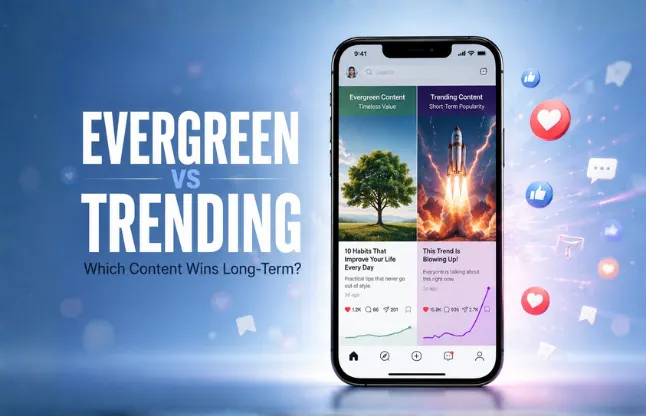
Evergreen Content vs Trending Content: Which Drives Better Long-Term Growth?
Creating content consistently sounds easy until you actually have to decide what to publish. Should you write about a topic people will still search for six months from now, or should you jump on something that is getting attention today? This is where the difference between evergreen content and trending content becomes important. Both can bring visitors, engagement, and brand awareness, but they work in very different ways.
I have seen many businesses make the mistake of choosing only one approach. Some focus entirely on timeless blog posts and slowly lose opportunities to participate in current conversations. Others chase every trend they can find and end up with a website full of articles that stop getting attention once the trend disappears. A stronger approach is to understand what each type of content does best and use both at the right time.
If your goal is sustainable growth, your content should not depend on one viral moment. You need a foundation that can continue bringing people to your website while also leaving enough room for fresh topics. That is why a balanced SEO content strategy, combined with smart content marketing and consistent social media marketing, can be much more effective than constantly guessing what will become popular next.
In this guide, I will break down evergreen and trending content in simple terms, explain when each one makes sense, and show you how to combine them without making your content calendar unnecessarily complicated. I will also cover how these strategies can work alongside social media growth and services such as SMM Panel Services.
What Is Evergreen Content?
Evergreen content is content that stays useful and relevant for a long period of time. It usually answers a question, solves a problem, teaches a skill, or provides information that people will continue to need regardless of what is currently trending. The topic may need occasional updates, but the basic reason people search for it does not disappear.
For example, an article explaining how to create a social media content calendar can remain useful for years. The platforms may introduce new features and the recommended posting frequency may change, but businesses and creators will still need to plan their content. The same applies to guides about SEO basics, social media marketing, writing captions, improving engagement, or choosing the right content format.
The biggest advantage of evergreen content is that it does not have to depend on a specific date. A well-written article can attract someone today, another visitor next month, and potentially many more people several months later. Instead of creating something that has one short moment of usefulness, you are building a digital resource that can continue working in the background.
What Is Trending Content?
Trending content is built around something that is currently receiving attention. It could be a viral topic, new social media feature, industry announcement, popular challenge, breaking development, trending search query, new platform update, or a conversation that suddenly becomes popular.
Imagine that Instagram launches a major new feature and millions of creators want to know how it works. A marketer who publishes a useful guide while people are actively searching for answers has a good opportunity to attract attention. If the article is accurate and genuinely helpful, it may receive traffic from search engines and social platforms while the topic is still fresh.
The problem is that trending content usually has a shorter lifespan. Interest can disappear just as quickly as it appeared. An article about a new feature may perform extremely well during the first few weeks but receive very little traffic later if the feature becomes old news or gets replaced. That does not make the content useless; it simply means its value is concentrated in a shorter period.
Evergreen Content vs Trending Content: What Is the Difference?
The easiest way to understand the difference is to think about time. Evergreen content is created for questions that people are likely to ask repeatedly, while trending content is created for questions people are asking right now. One is designed to build a stable foundation, while the other is designed to capture current attention.
Evergreen content is especially valuable for websites because it can support long-term search visibility. Trending content can be more useful when you want to react quickly to something people are already discussing. If you combine them properly, you do not have to choose between stability and speed.
Evergreen Content | Trending Content |
Focuses on long-term topics | Focuses on current topics |
Can generate traffic for months or years | Usually has a shorter traffic window |
Strong for SEO | Strong for immediate visibility |
Answers recurring questions | Responds to current interest |
Can be updated regularly | May become outdated quickly |
Builds a long-term content library | Creates short-term attention |
The important thing is not to ask which type is universally better. Instead, ask which type is better for the goal you are trying to achieve right now.
Why Evergreen Content Matters for Long-Term Growth
When I think about long-term content growth, evergreen articles are usually the first place I would start. They give a website a stable base because they focus on subjects that do not disappear after a few days. If the article is genuinely useful and optimized properly, it can continue attracting search traffic even while you are publishing new content.
This is particularly important for businesses that want to build organic visibility. You do not want your website to depend entirely on temporary spikes in traffic. A strong collection of useful articles can create multiple entry points for people searching for different questions related to your industry.
Evergreen Content Can Bring Consistent Search Traffic
One of the biggest benefits of evergreen content is its ability to support organic search over time. When people repeatedly search for a topic, a useful article has the opportunity to appear in front of those people again and again. It may take time to build rankings, but the potential value can last much longer than a short-lived social trend.
This is why evergreen topics should be an important part of your SEO content strategy. Instead of publishing articles simply because you need something new on your blog, look for questions your audience is likely to ask repeatedly. When you answer those questions properly, you are creating content with a reason to exist beyond the day it is published.
For example, an article about choosing the right social media marketing strategy can remain relevant for a long time. The platforms and tactics may change, but businesses will continue looking for ways to reach the right audience. That gives the topic lasting search value.
Evergreen Content Builds Authority
There is another benefit that is sometimes overlooked. Evergreen content can help establish your website as a useful source of information within your niche. When someone finds one helpful article and later discovers several other useful guides from the same website, they start becoming familiar with the brand.
That familiarity can be valuable when the person is eventually ready to buy a product or service. They may remember your website because you helped them solve a problem earlier. This is one of the reasons content marketing is more powerful when it is approached as a long-term relationship rather than simply a way to get clicks.
For a social media marketing website, this could mean publishing detailed resources about Instagram growth, social media strategy, engagement, content planning, SMM services, and related topics. Each article adds another useful resource to the overall website.
Why Trending Content Still Matters
If evergreen content is so useful, you might wonder why you should spend time creating trending topics at all. The answer is simple: trends can create opportunities that evergreen content cannot always provide.
When a topic suddenly becomes popular, people actively search for information about it. They may also discuss it on social media, share articles with friends, and follow accounts that provide useful explanations. If your brand can become part of that conversation at the right moment, you may reach people who would not have discovered you through traditional evergreen content.
Trending content is particularly useful for social media because platforms move quickly. New features, viral formats, popular sounds, creator discussions, and industry news can create opportunities for brands to show that they are paying attention.
Trending Content Can Generate Fast Visibility
Imagine a major social platform introduces an update that changes how creators publish content. Thousands of people immediately start searching for explanations. If you publish a clear guide within that period, your article can benefit from the sudden increase in interest.
This is very different from evergreen SEO, where you may have to wait weeks or months before seeing meaningful results. Trending content can sometimes generate traffic almost immediately because people are already looking for information.
However, speed matters. If you publish your response after everyone has already moved on, the opportunity may be much smaller. Trending content requires marketers to pay attention and act when the topic is actually relevant.
Trending Content Can Increase Social Media Engagement
Current topics naturally create conversations because people already have an opinion about them. If you add something useful, funny, educational, or interesting to the discussion, people may be more likely to comment or share it.
For example, instead of simply posting about a trending Instagram feature, a social media agency could explain what the change means for small businesses. That gives the audience a reason to respond because the content connects the trend to something they care about.
This is where social media marketing and content strategy overlap. You are not chasing a trend just because it is popular. You are using a relevant trend as an opportunity to provide something valuable to your audience.
The Biggest Weakness of Trending Content
The biggest problem with trending content is that it has an expiration date. Something can be extremely popular today and almost completely irrelevant a few months later. If your entire content strategy is based on trends, your traffic and engagement may rise sharply and then fall just as quickly.
There is also the risk of forcing trends that do not make sense for your brand. Not every viral topic deserves a response. If you constantly jump from one unrelated trend to another, your audience may struggle to understand what your brand actually represents.
A better approach is to choose trends that naturally fit your industry and audience. When a trend has a genuine connection to what you offer, participating feels natural. When there is no connection, it can look like you are simply trying to get attention.
Which One Should You Choose?
If your main goal is long-term growth, evergreen content should generally make up the foundation of your strategy. It can continue attracting organic traffic, answer recurring questions, build authority, and support your website for a much longer period.
But that does not mean trending content should be ignored. Trends can help you reach new people, create conversations, and increase short-term visibility. They can also make your brand feel current instead of disconnected from what your audience is discussing.
A practical strategy could be around 70% evergreen content and 30% trending content, although you do not need to follow that percentage strictly. A news-focused website may need far more trending content, while an SEO-focused business website may benefit from a larger evergreen library.
The main idea is simple: use evergreen content as your foundation and trending content as your opportunity to react quickly.
How to Create a Balanced Content Strategy
The first step is to identify the questions your audience will continue asking. Look at customer questions, search suggestions, comments, community discussions, and topics that consistently receive attention in your industry. These are the subjects that can become your evergreen content.
Once you have those topics, create detailed resources around them. Do not rush through the articles just to increase your publishing frequency. A useful guide that completely answers a question can be more valuable than five short posts that barely explain anything.
After building your evergreen foundation, leave some space in your calendar for current topics. Keep an eye on platform updates, industry news, seasonal events, and relevant social conversations. When something genuinely connects with your audience, create a timely piece around it.
This creates a healthy balance. Your evergreen articles continue working for long-term visibility, while your trending posts give you opportunities to participate in current conversations.
How to Turn One Evergreen Article Into Multiple Posts
Another reason evergreen content is so useful is that you can reuse it in different formats. You do not have to write a completely new article every time you need something for social media.
For example, one detailed article about Instagram growth could become several Instagram carousel posts, short videos, LinkedIn posts, email tips, social media graphics, and FAQ answers. Each version can focus on a different part of the original article while pointing interested users toward the full resource.
This is especially helpful for small businesses that do not have a large marketing team. Instead of constantly starting from a blank page, you can create one strong resource and repurpose it into several smaller pieces.
The same approach works with trending content too. If a trending topic produces strong engagement, you can later turn it into a more detailed evergreen guide once the initial excitement has settled. That way, a short-term opportunity can eventually become a long-term asset.
How Free Instagram Views, Likes, and Followers Fit Into Content Strategy
People often search for Free Instagram Views, Free Instagram Likes, and Free Instagram Followers because they want to increase visibility without spending a lot of money. Those searches can also reveal something important about your audience: people are interested in growth, visibility, and social proof.
However, numbers alone do not create a successful social media presence. If someone visits your profile and finds content that is irrelevant, repetitive, or unhelpful, a larger number of views or followers will not automatically turn into meaningful engagement.
A better approach is to combine visibility efforts with strong content. Use useful posts, engaging videos, relevant trends, consistent branding, and genuine conversations to give people a reason to stay. Whether you are using free strategies or paid services, the content itself still needs to provide value.
If you are exploring services related to social media growth, you may come across platforms such as InstantLikes. These services can be considered as part of a broader visibility strategy, but they should support your content rather than replace it. The goal should always be to turn attention into an audience that actually cares about what you publish.
Where SMM Panel Services Fit Into the Strategy
SMM Panel Services can be another part of a wider social media growth plan. Depending on your goals and the provider you choose, these services may help support visibility across different platforms.
However, I would not recommend treating an SMM panel as your entire marketing strategy. Think of it as one piece of a larger system. Your content attracts attention, your profile builds trust, your engagement creates relationships, and your offers give people a reason to become customers.
For businesses researching social media growth solutions, TopsmmAgency can be considered alongside other providers when comparing available SMM services. The important thing is to understand what you are buying, what your actual objective is, and how the service fits into your wider marketing plan.
If your audience includes customers in India, searches for SMM Panel India can also be relevant when developing location-focused content. At the same time, a global business should not limit its content to one country when its services are available internationally. Country-specific pages should provide genuinely useful local information rather than simply adding a country name to a generic article.
How to Refresh Your Evergreen Content
Calling something evergreen does not mean you should publish it once and forget about it. Even a timeless topic can become outdated when platforms, technologies, statistics, or recommendations change.
Take an article about Instagram marketing as an example. The general idea of building an audience may remain relevant for years, but Instagram features, content formats, analytics, and best practices can change. If you never update the article, it may eventually provide outdated advice.
Review your strongest evergreen pages periodically. Check for broken links, old screenshots, outdated statistics, missing information, and changes in platform features. Adding fresh examples and answering new questions can also make the article more useful.
This is one of the easiest ways to get more value from content you have already created. Instead of always starting from scratch, you can improve an existing asset that already has search history, backlinks, or returning visitors.
How to Measure Evergreen and Trending Content
Do not measure both types of content in exactly the same way. Their purposes are different, so the numbers you pay attention to should also be different.
For evergreen articles, look at organic traffic, search impressions, keyword rankings, returning visitors, engagement, and conversions over several months. A successful evergreen article may not explode immediately, but it can gradually become one of the most reliable traffic sources on your website.
Trending content should be judged more quickly. Look at reach, shares, comments, mentions, profile visits, engagement rate, and traffic during the period when the topic is popular. A trending article can be successful even if its traffic drops later because its purpose was to capture short-term attention.
The key is to measure the content according to the job you expected it to perform. If you expect a trend article to generate traffic forever, you may think it failed when it was actually successful. If you expect an evergreen article to become viral overnight, you may abandon it before it has had enough time to grow.
A Simple Monthly Content Plan
If you are unsure where to start, keep your monthly content calendar simple. During the first week, publish one detailed evergreen article that answers an important question your audience regularly searches for. Spend enough time making it genuinely useful instead of trying to publish as quickly as possible.
During the second week, look for a relevant trend and create content around it if the topic genuinely fits your audience. During the third week, return to another evergreen topic and build a second long-term resource. During the final week, publish another timely post or repurpose one of your strongest articles into social media content.
This approach gives you consistency without forcing you to choose between SEO and social media. You are steadily building your website while still participating in current conversations.
Common Mistakes to Avoid
One common mistake is relying entirely on trends. If your content library contains only temporary topics, your website may struggle to generate consistent traffic once those topics lose popularity. Trends are useful, but they should not become the entire foundation of your strategy.
Another mistake is creating only evergreen content and never responding to what people are currently discussing. A website can have excellent educational resources while its social media presence feels inactive or disconnected. Current conversations can create opportunities that long-term topics cannot.
It is also a mistake to chase every trend simply because it has millions of views. Ask whether the trend is relevant to your audience before creating content around it. If there is no natural connection, the content may attract attention from people who have no interest in your business.
Finally, do not forget to update your best content. Even a strong evergreen article can lose value when information becomes outdated. Regular improvements can keep your content useful and competitive.
Final Verdict: Evergreen Content Should Be Your Foundation
So, evergreen content vs trending content — which one drives better long-term growth? If your goal is sustainable traffic, search visibility, and a strong content library, evergreen content should take the leading role. It gives you resources that can continue attracting visitors and answering questions long after publication.
But trending content still has an important place in a modern marketing strategy. It can help you react to current conversations, attract quick attention, increase social media engagement, and introduce your brand to people who may not have discovered it through search.
The smartest strategy is not about choosing one and completely ignoring the other. Build your foundation with evergreen content, then use relevant trends to add freshness and reach. Let your SEO content strategy create long-term value while your social media marketing responds to what people care about today.
Whether someone finds you while searching for Free Instagram Views, Free Instagram Likes, Free Instagram Followers, SMM Panel Services, or broader content marketing information, the same principle applies: attention is useful, but value is what keeps people around.
A trend can bring someone to your website today. A genuinely useful piece of evergreen content can give that person a reason to return six months from now. That is why the strongest content strategies do not chase every trend or ignore every trend. They build something lasting while staying ready to take advantage of the right opportunity.
Frequently Asked Questions (FAQs)
1. What is the difference between evergreen content and trending content?
Evergreen content focuses on topics that remain useful and searchable for a long time, such as guides, tutorials, and frequently asked questions. Trending content focuses on current events, viral topics, or popular discussions that generate attention for a shorter period. Both are useful, but they serve different purposes in a content strategy.
2. Which is better for long-term SEO growth: evergreen or trending content?
Evergreen content is generally better for long-term SEO growth because people can continue searching for the topic months or even years after publication. Trending content may generate quick traffic, but its popularity often declines once public interest moves to another topic. A strong SEO content strategy should primarily use evergreen content while leaving room for relevant trends.
3. How much evergreen and trending content should I publish?
A balanced approach for many businesses is to focus around 70% of content on evergreen topics and 30% on trending or timely topics. However, the ideal ratio depends on your industry and audience. The main goal is to build a reliable content foundation while still taking advantage of relevant opportunities.
4. Can trending content help improve social media engagement?
Yes, trending content can increase social media engagement because people are already interested in the topic and actively discussing it. When a brand adds useful insights, relatable opinions, or educational information, users may be more likely to comment, share, or interact. The key is choosing trends that genuinely connect with your audience.
5. How do SMM Panel Services fit into a content marketing strategy?
SMM Panel Services can support a broader social media growth strategy, but they should not replace valuable content and genuine audience interaction. Strong evergreen and trending content gives people a reason to follow and engage with your brand. Growth tools can support visibility, while quality content helps build long-term audience relationships.
- No Comments
- August 31, 2026