
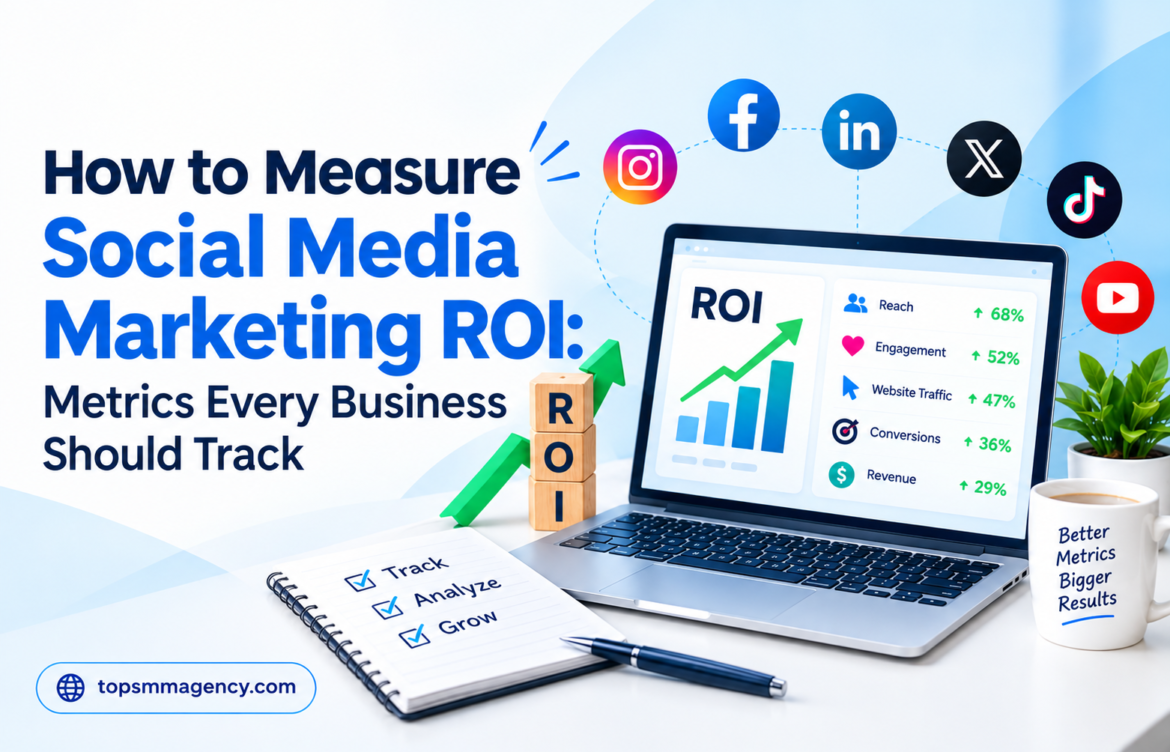
How to Measure Social Media Marketing ROI: Metrics Every Business Should Track
Social media can bring attention to a business very quickly, but attention alone does not always mean business growth. A post may receive thousands of views, hundreds of likes, or a large number of followers, yet you may still wonder whether those results are actually helping your business make money. That is where Social Media Marketing ROI becomes important.
Measuring social media ROI helps you understand what you are getting back from the time, money, content, advertising, and social media marketing services you invest in. Instead of looking only at follower counts, you can track reach, engagement, leads, conversions, customer acquisition, and actual revenue to see what is working.
For businesses of all sizes, the goal should not simply be to become popular on social media. The bigger question is whether your social media activity is helping you attract the right audience, build trust, generate enquiries, increase sales, and support long-term growth.
What Is Social Media Marketing ROI?
Social Media Marketing ROI is the value a business receives from its social media investment compared with what it spends on that investment. In simple terms, it answers one important question: “Is the money and effort we put into social media producing worthwhile results?”
The investment can include much more than advertising costs. You may spend money on content creation, graphic design, video production, influencers, social media marketing services, management tools, employees, or SMM Panel Services. Your time can also be considered an investment if you or your team spend hours managing social accounts.
A basic ROI formula is:
Social Media ROI = (Return from Social Media − Social Media Investment) ÷ Social Media Investment × 100
For example, imagine a business spends $500 on social media activities and generates $1,500 in trackable sales from those efforts. The return is $1,000 after subtracting the original investment, giving the business a 200% ROI.
The exact calculation can become more complicated when several channels and campaigns are involved, but the principle remains the same: measure what you put in and compare it with the value you get back.
Why Measuring Social Media ROI Matters
Without measurement, social media marketing can easily become a guessing game. You may continue creating content because a post looks popular, even though another campaign with fewer likes is actually producing more customers.
This is especially important for small businesses with limited budgets. If you are spending money on content, advertising, social media marketing services, or other growth activities, you need to know where that money is going and whether it is contributing to your business goals.
Measuring Social Media ROI also helps you make better decisions over time. Instead of asking which post received the most likes, you can ask which campaign generated the most qualified leads, which platform brought the most customers, and which type of content helped people move closer to making a purchase.
That difference can completely change the way you approach social media.
1. Start With Reach and Impressions
Reach is one of the easiest social media metrics to understand. It tells you approximately how many unique people saw your content, while impressions generally represent the number of times content was displayed.
These numbers are useful because they show whether your content is getting in front of people. If your reach is consistently increasing, your brand may be becoming more visible within your target market.
However, reach should not be treated as revenue. A post reaching 100,000 people does not automatically mean that 100,000 potential customers are interested in your product. Use reach as an awareness metric, then connect it with deeper metrics such as engagement, website visits, leads, and conversions.
For example, a local business might discover that one type of educational Reel gets significantly more reach than promotional posts. That information can help the business create more content around topics people already care about.
2. Track Engagement, Not Just Likes
Engagement tells you how people interact with your content. Depending on the platform, this can include likes, comments, shares, saves, replies, clicks, mentions, and other interactions.
A high engagement rate can indicate that your content is relevant to the people seeing it. Shares and saves can be particularly useful because they may show stronger interest than a simple like.
Still, engagement needs context. A funny post might generate thousands of interactions but bring almost no customers. Another post might receive fewer interactions but generate several valuable enquiries.
That is why businesses should connect engagement data with their actual goals. If your objective is brand awareness, engagement may be an important success indicator. If your objective is sales, you eventually need to connect those interactions with website visits, leads, purchases, or other measurable actions.
3. Measure Website Traffic From Social Media
One of the best ways to understand whether social media is driving real interest is to monitor the traffic coming from social platforms to your website.
Look at how many people visit your website from Instagram, Facebook, YouTube, TikTok, LinkedIn, or other channels. Then check what those visitors do after arriving.
Do they view product pages? Read your blog? Fill out a contact form? Sign up for something? Start a purchase? Leave immediately?
These details help you understand the quality of your social traffic.
You can also use tracking links, such as UTM parameters, to identify exactly which campaign or post generated a website visit. This makes your Social Media ROI calculations much more reliable because you are not relying entirely on assumptions.
For example, if an Instagram campaign sends 2,000 visitors to your website and another sends only 500, the first campaign may look better at first. But if the second campaign generates twice as many enquiries, the smaller campaign may actually be more valuable.
4. Track Leads Generated From Social Media
For many businesses, a lead is more meaningful than a like or follower.
A lead could be someone who submits a contact form, requests a quote, sends a business enquiry, signs up for an email list, books a consultation, or contacts the business through a social platform.
Track how many leads each social channel generates and where those leads came from. This gives you a clearer picture of which platforms are contributing to your sales pipeline.
You can also measure cost per lead:
Cost Per Lead = Total Social Media Spend ÷ Number of Leads
Suppose you spend $1,000 on a campaign and receive 100 leads. Your cost per lead is $10.
That number becomes even more useful when you compare it with the average value of your customers. A $10 lead may be excellent for one business and too expensive for another, depending on conversion rates and customer value.
5. Measure Conversion Rate
A conversion happens when a user takes the action you want. Depending on your business, this could be a purchase, registration, booking, subscription, download, enquiry, or another valuable action.
Conversion rate helps you understand how effectively your social traffic is turning into meaningful actions.
For example:
Conversion Rate = Conversions ÷ Total Visitors × 100
If 1,000 people visit your website from social media and 50 complete a purchase or enquiry, your conversion rate is 5%.
This metric becomes much more useful when broken down by campaign and platform. You may discover that Instagram produces the most traffic while another channel produces fewer visitors but a higher percentage of paying customers.
That is the kind of information you need when measuring Social Media ROI.
6. Calculate Customer Acquisition Cost
Customer Acquisition Cost, commonly called CAC, tells you how much it costs to acquire a new customer.
A simple calculation is:
CAC = Total Marketing and Sales Cost ÷ Number of New Customers
Suppose you spend $2,000 on social media campaigns and related marketing costs and gain 40 new customers. Your acquisition cost would be $50 per customer.
Now compare that with the average revenue or profit generated by those customers. If the average customer generates significantly more value than your acquisition cost, the campaign may have room to scale.
This is also why businesses should not judge a social media campaign based only on its upfront cost. Customer value can continue beyond the first purchase.
7. Look at Customer Lifetime Value
Customer Lifetime Value, or CLV, estimates how much revenue or profit a customer may generate throughout their relationship with your business.
This is particularly useful for businesses that depend on repeat purchases, subscriptions, memberships, or recurring services.
Imagine two social campaigns each generate 20 new customers. Campaign A produces customers who purchase once, while Campaign B attracts customers who return several times during the year.
If you only look at the number of customers, the campaigns appear equal. Once customer lifetime value is considered, the difference becomes much clearer.
This is one reason why serious ROI measurement goes beyond vanity metrics.
8. Track Revenue Attributed to Social Media
Revenue is one of the strongest metrics for understanding business impact.
Whenever possible, connect purchases and sales back to their original marketing source. This can be done using analytics platforms, campaign tracking, ecommerce reporting, CRM systems, discount codes, referral links, or other attribution methods.
Attribution is not always perfect. Someone might discover your brand through Instagram, visit your website later through Google, and finally purchase after receiving an email. Deciding which channel deserves credit can be complicated.
Because of this, treat attribution data as a useful measurement system rather than an absolute representation of every customer journey.
The goal is to identify patterns and understand how social media contributes to the overall buying process.
9. Understand the Difference Between Vanity Metrics and Business Metrics
Followers, likes, views, and impressions are not useless. They simply should not be the only things you measure.
These are often called vanity metrics because they can look impressive without necessarily showing business results.
Imagine one account has 100,000 followers but generates very few enquiries. Another has 10,000 followers and regularly converts followers into customers. The larger account is not automatically creating more business value.
For this reason, build a measurement system that includes both visibility metrics and business metrics.
A useful dashboard could include:
- Reach
- Impressions
- Engagement rate
- Website clicks
- Leads
- Conversion rate
- Cost per lead
- Customer acquisition cost
- Revenue
- Customer lifetime value
- Social Media ROI
Looking at these numbers together gives you a much clearer picture.
10. Measure the Performance of Different Content Types
Not every post has the same purpose.
Educational content may help build trust. Product demonstrations can help people understand what you offer. Testimonials can provide social proof. Reels and short videos may increase reach, while detailed posts may generate stronger conversations.
Instead of simply asking which post got the most views, categorize your content and compare performance.
You might find that educational content generates the most saves, promotional content generates the most website clicks, and customer stories generate the most enquiries.
That information can help you create a more balanced content strategy.
11. Compare Organic and Paid Social Results
Businesses often combine organic social media with paid campaigns. Measuring them separately can help you understand where your investment is producing results.
Organic content may require more time and consistency but can continue attracting attention without paying for every impression. Paid advertising can provide more controlled targeting and faster reach, but it requires a budget.
You should compare metrics such as reach, engagement, website traffic, leads, conversions, and acquisition cost across both approaches.
The goal is not necessarily to choose one and ignore the other. A strong strategy can use organic content to build credibility while paid campaigns help distribute specific offers or reach selected audiences.
12. Where SMM Panel Services Fit Into Measurement
Businesses sometimes use SMM Panel Services as part of their social media growth strategy. These services can include different types of social media support, depending on the provider and platform.
If you use an SMM Panel, measurement becomes especially important. Do not judge a service simply by the number of followers, likes, or views delivered.
Ask what business objective the activity supports. Is it helping improve visibility? Is it supporting content distribution? Is it helping establish an active-looking profile while you build genuine audience engagement through your content strategy?
An SMM Panel should be treated as one part of a wider social media strategy rather than a replacement for quality content, customer interaction, or genuine marketing.
For businesses researching options in different markets, searches such as SMM Panel India can also bring up a wide range of providers. Compare services carefully, understand what is included, and focus on measurable outcomes rather than choosing a provider purely because it promises a large number of interactions.
13. Measure Social Media Marketing Services Properly
If you hire external social media marketing services, ask for reporting that connects activity with business outcomes.
A useful monthly report should show more than follower growth. It can include reach, engagement, website traffic, leads, conversions, campaign performance, and other metrics that match your business goals.
You should also know what changed from one month to the next. If website traffic increased, what caused the increase? If leads dropped, which campaign or platform contributed to the change?
Good reporting should help you make decisions, not simply give you a collection of impressive numbers.
14. Set a Clear ROI Goal Before Starting a Campaign
One common mistake is launching a campaign first and deciding what success means later.
Before publishing or spending money, decide what you want the campaign to accomplish.
For example, your goal could be:
“Generate 100 qualified leads within 60 days at an average cost of no more than $15 per lead.”
Now your measurement system has a clear direction.
Another campaign might focus on website sales, while a brand-awareness campaign might focus more heavily on reach and engagement. The important thing is to select metrics that match the actual purpose of the campaign.
15. Give Your Campaign Enough Time to Produce Useful Data
Not every campaign should be judged after a few hours.
Some content receives immediate attention, while other campaigns build results gradually. If you change your strategy every time a post performs below expectations, you may never collect enough information to identify meaningful patterns.
Set a reasonable measurement period and review results consistently.
At the same time, do not continue spending money indefinitely on a campaign that is clearly failing to meet its objective. Good ROI measurement means being patient enough to collect useful data while remaining willing to make changes when the evidence points in another direction.
How to Build a Simple Social Media ROI Dashboard
You do not need an overly complicated system to start measuring performance.
A simple spreadsheet or analytics dashboard can contain columns for platform, campaign, investment, reach, engagement, website visits, leads, conversions, customers, revenue, and ROI.
Update the information regularly and compare results over time.
For example, your monthly review could look at:
Instagram: Reach → Engagement → Website Visits → Leads → Customers → Revenue
Facebook: Reach → Engagement → Website Visits → Leads → Customers → Revenue
TikTok: Reach → Engagement → Website Visits → Leads → Customers → Revenue
YouTube: Views → Engagement → Website Visits → Leads → Customers → Revenue
The exact metrics will depend on your business model, but the basic idea is simple: follow the customer journey from attention to action.
Use Data to Improve Your Next Campaign
The real benefit of measuring ROI is not simply knowing what happened. It is using that information to make your next campaign better.
If a campaign produced strong reach but weak conversions, you might need to improve your landing page, offer, targeting, or call to action. If engagement was high but website traffic was low, your content may need a clearer reason for people to click.
If a campaign generated sales at a sustainable acquisition cost, you can study what made it successful and test similar approaches.
This creates a cycle:
Create → Measure → Learn → Improve → Repeat.
That process is much more valuable than chasing viral numbers without understanding what they mean for your business.
Can Social Media ROI Be Measured Accurately?
Yes, but not every result can be measured perfectly.
Some customer journeys are direct. A person clicks an advertisement, visits a website, and makes a purchase. That journey is relatively easy to track.
Other journeys are less straightforward. Someone might see your Instagram content today, search for your brand next week, read reviews, and purchase a month later. Social media may have influenced the decision even though the final conversion was recorded through another channel.
For this reason, businesses should use multiple metrics rather than relying on a single ROI number.
Look at the complete picture: reach, engagement, traffic, leads, conversions, customer acquisition, revenue, and customer value.
Final Thoughts
Measuring Social Media Marketing ROI does not mean ignoring likes, followers, views, or engagement. It means putting those numbers into the right context.
A growing follower count can be useful. Strong engagement can be encouraging. High reach can improve brand visibility. But the real value becomes clearer when you connect social media activity with website traffic, leads, customers, revenue, and long-term business growth.
Whether you manage your accounts internally, work with social media marketing services, or use selected SMM Panel Services, your focus should remain on measurable objectives. Tools and services can support your strategy, but they should not replace good content, audience understanding, customer service, and proper tracking.
For businesses exploring social media growth tools and services, TopsmmAgency can be one place to research different approaches and understand how social media activity fits into a broader marketing strategy. If your goal is to build stronger social proof and improve the visibility of your social profiles, you can also explore InstantLikes through instantlikes.co and evaluate the available options according to your own campaign goals.
The most important lesson is simple: do not measure social media only by how busy your profile looks. Measure what it contributes to your business. Once you start connecting social activity with real business outcomes, it becomes much easier to understand where your budget and effort are actually working.
Frequently Asked Questions (FAQs)
1. What is Social Media Marketing ROI?
Social Media Marketing ROI measures the value a business gets from its social media investment compared with the money and resources spent.
2. Which metrics should businesses track for social media ROI?
Businesses should track reach, engagement, website traffic, leads, conversions, customer acquisition cost, revenue, and overall ROI.
3. Are followers and likes enough to measure Social Media ROI?
No. Followers and likes show engagement and visibility, but businesses should also measure leads, sales, conversions, and revenue.
4. Can SMM Panel Services help improve social media results?
SMM Panel Services can support certain social media growth activities, but they should be used alongside quality content, genuine engagement, and a clear marketing strategy.
5. How can businesses calculate Social Media ROI?
A basic formula is: (Return from Social Media − Social Media Investment) ÷ Social Media Investment × 100.
- No Comments
- September 18, 2026